“The incarceration of Aboriginal women a national shame.” said June Oscar, Aboriginal and Torres Strait Islander Social Justice Commissioner, on May 2nd, 2018, when delivering the Grace Vaughan Memorial Lecture at the University of Western Australia. Indigenous women make up 34 per cent of all female prisoners but only 2 per cent of the Australian population. “The trajectory of incarceration in this nation shines a glaring light on the systemic inequality experienced by Aboriginal and Torres Strait Islander peoples,” she told a Perth audience in delivering the Grace Vaughan Memorial Lecture at the University of Western Australia.
There has been a 77 per cent increase in the number of women jailed in the decade to 2007, “and it is indigenous women who account for most of this growth”. A decade later, WA had recorded the highest jailing rates of indigenous people in the country, and 22 per cent of its Aboriginal prison population in 2017 were women. June Oscar believes that this does not reflect who we are as a nation. She feels to bring about national equality, we need to begin listening to those who experience the greatest injustices. According to the Sisters Inside founder, Debbie Kilroy, prison has become a place for warehousing people with mental illness, disability and substance abuse. “We know,” says Kilroy, “that the issues that present for women in prison are about poverty and homelessness. Prison is the default response for poverty, homelessness, mental health, drug addiction, abused women. “We know that many women in prison can’t even read or write. The incarceration of Torres Strait Islander and Aboriginal women has increased 640% in the last 20 years and they are the ones who are the most brutalised.
Their plea is for rehabilitation, rather than jail, where they can grow on a personal level and come back to society with increased social skills. Often Aboriginal women are imprisoned for insignificant crimes. I listened to an ABC program about this in 2016. At that time Indigenous Women were 24 times more likely to be imprisoned for the same crime as non-Indigenous women. I was so disturbed by this that it inspired me to make an artwork to raise awareness of this fact.
Christine Latham
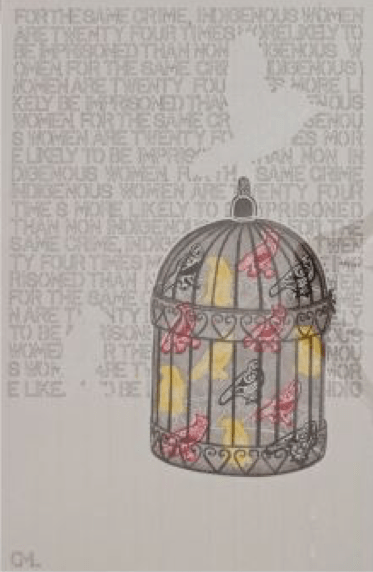
Title: For The Same Crime”
Artist: Christine Latham (Yamatji)
Media:
Lino print and stencil on paper Indigenous coloured birds are trapped in a cage that looks fancy from the outside, but is actually controlled by white supremacy (the white bird with the cage in its beak high on its flying high on its misdemeanors) while the rest of the white world looks on ineffectually (the white bird on the left). The background stenciling reflects the statistics at the time.

 Puzzle Creek Press
Indigenous women make up 34% of the female prison population but only 2% of the Australian population. Isn’t that more a reflection on who is offending? The article implies there is racism behind the level of incarceration, but that would then be a reflection on the Magistrates/Judges, not anyone else (if it were down to racism).
According to the article, in 2016 indigenous women were 24 times more likely to be imprisoned than non-indigenous women for the same offence. That statistic tells us nothing. It has no contextualisation other than flashing the race card and implying that idegenous women are treated more harshly than non-indigenous women. However, what about their criminal histories? Does the statistic take that into account? Should an indigenous woman have committed common assault, with zero history, I would expect her to not be imprisoned. Should a non-indigenous woman commit the same offence and have a long history for the same offences, I would expect the non-indigenous woman to be penalised more harshly.
These cherry-picked statistics are misleading and do not accurately reflect anything other than indigenous women are more likely to commit offences than non-indigenous women.
LikeLike