For more than a decade we’ve heard scientist’s predictions of the catastrophic impacts of climate change. These same scientists that are never questioned when they create new life-saving drugs or develop new technology we rely on have been warning us of increased frequency and more intense fires, increased intensity of extreme weather events, and increased drought as a result of climate change. The impacts have now sadly become a part of our lived experience.
During the last summer break I visited Tasmania, arriving to dry lightning strikes across a state parched by lack of rain and uncharacteristic waves of 35oC plus heat. A month later 200,000 ha of forest and wilderness had burned. National Parks right across the state had closed over the busiest part of the tourist season and hundreds if not thousands of employees across the sector watched their incomes wither. Businesses such as the iconic Tahune Air Walk were burned and employment for its workers vanished into the ash. Asthma sufferers and the elderly struggled during months of gagging smoke and heat. On the flight back to Sydney acrid smoke from Victorian bushfires filled the cabin, creating a sense of impending doom. Driving back through central NSW, drought and heat had reduced the environment and farms beside the highway to a barren wasteland. The incomes of farmers and graziers withered away under the blazing heat and cloudless sky. Back home in Townsville, extreme rainfall swept half a million cattle away, destroyed local businesses and inundated our friend’s and colleague’s homes. These events caused billions of dollars of damage, destroyed peoples livelihoods and left a mountain of carcasses drowned. To this day one thousand people still remain homeless in Townsville. Climate change impacts are now our day-to-day reality.
According to the Australian Bureau of Meteorology and IPCC, the planet as a whole has only warmed by an average of 1oC since 1910. However fluctuations in temperature across the world mean some locations experience greater increases. For example, in Australia, our last summer of which I mention was a scorcher coming in at 2.1oC above the average. The need for action to reduce the greenhouse gas emissions causing this heat is already a life and death concern. Considering an ambitious scenario, scientists suggest that if we can manage to cut our emissions by 45% by 2030 the impacts will get worse but we’ll at least (conservatively) keep the planetary average to 1.5oC above the average. This is a 50% greater increase than we have now. With such a massive challenge ahead of us and with a federal election looming there is no better time than now to reflect on our collective progress in reducing emissions, understand the role that politics plays in assisting that transition, and best determine how we might be able to influence that trajectory.
Unfortunately all is not well and the Australian Government’s own emissions inventory data shows a steady increase in carbon emissions – in the last year alone green-house gas emissions increased by 0.9%. “Put more panels on your roof, turn off the lights and turn down your air-conditioners” are arguments we hear every day, encouraging the false promise that we as individuals and our actions are all that is necessary to achieve the emissions reductions that are necessary. A closer inspection of the government’s data shows that we’ve been doing just that and emissions in the electricity sector have been steadily dropping (3% decrease 2018). We have the highest uptake of household solar PV systems in the world. Despite the furious lobbying of corporates and coal zealots who attempt to steer us away from cheaper and cleaner renewable energy, we are slowly but surely winning the electricity battle, but in the real war on emissions we are losing badly.
Emissions from other sectors of the economy are increasing at an even faster rate, completely beyond your or my control. Take for example only the accidental or fugitive emissions from the oil and gas sector (leaks and flaring – that kind of thing), currently representing a massive 10% of Australia’s total greenhouse gas emissions and growing at 7.3% in 2018 alone. One of our biggest export industries, the gas industry, export 96% of what they extract out of the ground to overseas buyers. As a nation we could all go cold turkey on gas and we’d make almost no impact on those emissions whatsoever. With the full support of both State and Federal Governments they’re also gunning for massive expansion into the future. Leaving that expansion aside, imagine for a moment we cut our electricity emissions by 45% to meet those IPCC targets by 2030, in an attempt to create a future in which our livelihoods are not destroyed. Also ignore the fact that emissions in transport (diesel), manufacturing and stationary energy (together representing 44% of total emissions) are also increasing annually at 4% combined (2018). Those accidental emissions alone, of which we have no influence over, will wipe that 45% reduction to a measly 8%, rendering our collective efforts to reduce emissions to almost no gain.
We could hope for a change of heart from the oil and gas sector, but in the real world it is only government action at the federal level, through industry-wide regulation to force emissions reductions, that will solve this problem. So who is best placed to govern and regulate in our interest? In conclusion, I leave you a graph of greenhouse gas emissions over time extracted directly from the government’s own data, overlaid with ruling party. While neither major party act with anywhere near the urgency required, at least in the coming election we have a brief moment to choose a slightly safer path.
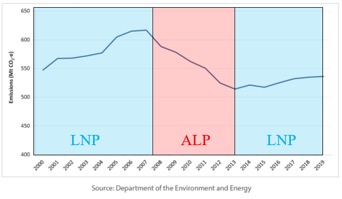
Reproduced from: ‘Quarterly Update of Australia’s National Greenhouse Gas Inventory: September 2018, Commonwealth of Australia 2018.
Dr Madoc Sheehan
Chemical Engineering Sustainability & energy systems modelling
References
BOM 2018, State of the climate 2018, accessed March 2019, <http://www.bom.gov.au/state-of-the-climate/australias-changing-climate.shtml>
IPCC 2018, IPCC Special report Global warming of 1.5oC, accessed March 2019, <https://www.ipcc.ch/sr15/>
Australian Government 2018, Australian Energy Update, Commonwealth of Australia 2018, accessed March 2019, <https://www.energy.gov.au/sites/default/files/australian_energy_update_2018.pdf date>

 Puzzle Creek Press