Modern democracy is built upon the ideal that the members of that society have a right to shape the governing systems of power under which they reside. However, there are some who view public participation in the democratic process as a threat to stability. Reinhold Niebuhr, a leading 20th century intellectual, claimed that the threat to state and economic stability could be laid at the feet of ‘the stupidity of the average man.’1, 2 Because of this stupidity—as Niebuhr and others see it—the democratic system threatens the stable order of society. Similarly, Harold Laswell in 1933, argued that ‘we should not succumb to “democratic dogmatisms about men being the best judges of their own interests,” they are not; the best judges are the elites, who must, therefore, be ensured the means to impose their will, for the common good.’3
What are the means by which the elites impose their will?
Edward Bernays, who was instrumental in the development of modern systems of mass media and advertising, devised a process of influencing mass opinion to the benefit of the elites. He wrote: ‘Public opinion can be manipulated’, suggesting that the public must be told what it is they want, and by doing so ‘the manipulator is safeguarding the public against [their] own possible aggressiveness.’4 This attitude towards the population is foundational to the strategies employed by the contemporary media institutions that deliver information to the masses; it is an attitude which asserts that if the masses are not told what they want, they would behave like ‘plunging hordes of lemmings into the sea.’5
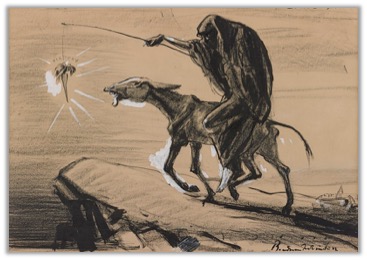
It is my contention that the climate of apathy in this country—political or otherwise—is partly a result of our collective awareness that the carrot dangled in front of us is meaningless and not what we truly desire.
The things that are said to fill our empty hearts and heads do not satisfy. We sit in front of our screens as atomized individuals in individual living rooms, wondering what we could do to make a difference.
But don’t think that I write this from a pedestal. I write not just to you but to myself also, for I am no stranger to apathy.
It is our responsibility to reach out to one another, to discuss and decide what it is that we want, and assert this through our democratic rights. It is our responsibility to envision with our fellows a meaningful life, and through the free association of ordinary citizens construct a society we look at and call good.
What is it that we want? How do we wish to live?
That is certainly not for me to say. But if a better world is to be realised, our decisions must be unconstrained by the powers that have always sought to constrain them.
Tully Baird
References
Niebuhr, R. (1960). Moral Man and Immoral Society: A Study in Ethics and Politics. 1932. New York: Charles Scribner’s Sons
Fox, R. W. (1986). Reinhold Niebuhr: a biography.
Chomsky, N. (1995). Necessary illusions: Thought control in democratic societies. House of Anansi.
Bernays, E. (1928). Manipulating public opinion. American Journal of Sociology, 33(3), 958.
Bernays, E. (1928). Manipulating public opinion. American Journal of Sociology, 33(3), 958.
Namier, L. (1963). England in the Age of the American Revolution.

 Puzzle Creek Press